
In the evolving landscape of global higher education, universities are increasingly called upon to redefine their roles—not merely as centers of learning, but as dynamic agents of sustainable development and international collaboration. This transformation is driven by two interrelated strategies: the integration of the United Nations Sustainable Development Goals (SDGs) and the strategic internationalization of academic institutions. Though distinct in focus, these approaches are deeply interconnected, forming a synergistic framework that enhances institutional growth, global relevance, and societal impact.
The SDGs, adopted by the United Nations in 2015, offer a universal blueprint for addressing critical global challenges such as poverty, inequality, climate change, and access to quality education. For universities, these goals serve as a strategic compass, guiding the alignment of core functions—research, teaching, operations, and community engagement—with global priorities. As Leal Filho et al. (2021) emphasize, embedding the SDGs into university programs not only strengthens institutional effectiveness but also fosters global citizenship among students, preparing them to address complex societal issues through interdisciplinary and ethical lenses.
This alignment with the SDGs is increasingly reflected in global university rankings, which now recognize and reward institutions for their contributions to sustainable development. The Times Higher Education (THE) Impact Rankings, for instance, evaluate universities based on their performance in SDG 17 (Partnerships for the Goals) and three other SDGs where they demonstrate particular strength. The methodology prioritizes research outputs, community outreach, teaching practices, and institutional stewardship—making it especially relevant for universities that document policy influence, sustainability research, and civic engagement (Hazelkorn, 2015).
Complementing THE Impact Rankings is the UI GreenMetric, which focuses specifically on environmental sustainability. This ranking system assesses quantitative data on energy consumption, waste management, water usage, transportation systems, and green infrastructure. Universities that invest in carbon neutrality, renewable energy, and eco-friendly operations can leverage UI GreenMetric to showcase their environmental leadership and commitment to sustainable campus development (Suwartha & Sari, 2013).
Adding another dimension is the World University Ranking for Innovation (WURI), which shifts the focus from traditional academic metrics to innovation, adaptability, and future-readiness. WURI evaluates institutions based on industrial application, entrepreneurial spirit, ethical value, and student mobility. Universities with unique programs, strong industry partnerships, and innovative pedagogical approaches are well-positioned to excel in this ranking, which rewards practical achievements and creative problem-solving (Heng & Sok, 2025).
Parallel to the SDG movement, universities—particularly in the Philippines—are actively pursuing strategic internationalization. This initiative is not only aligned with global trends but also supported by robust national policies and legislation. The Commission on Higher Education (CHED) has laid a strong foundation through memoranda such as CMO No. 55, Series of 2016, which outlines the policy framework for internationalization. Additional policies, including CMO 1, s. 2000 (international linkages), CMO 62, s. 2016 (transnational education), and CMO 7, s. 2017 (joint niche programs), further reinforce the legal and strategic support for global engagement. Republic Acts 11448 and 10650 also provide legal backing for transnational and open distance learning, respectively (Obquia & Sarmiento, 2025; Madula, 2018).
Internationalization offers a wide array of institutional benefits. Compliance with CHED policies can unlock grants, institutional autonomy, and program exemptions. It also enhances competitiveness in the local education market, attracting both Filipino and international students. Financial sustainability is another key advantage, as universities can diversify income through international tuition, research grants, and global partnerships. More importantly, internationalization drives improvements in academic quality, research excellence, and service delivery, while preparing graduates to thrive in a global workforce (Chao, 2022; Gao, 2019).
CHED recognizes a tiered ecosystem of global rankings that universities can strategically navigate. Tier 1 rankings, such as QS World University Rankings and THE, emphasize academic reputation, research citations, international faculty and student ratios, and sustainability. Tier 2 rankings, including UI GreenMetric, WURI, and AppliedHE, focus on specialized strengths such as sustainability, innovation, and employability, particularly within the ASEAN region (Alberti et al., 2025; Galleli et al., 2021). Additionally, QS Stars, a diagnostic rating system, provides a holistic view of institutional performance across multiple categories. Though not a ranking per se, QS Stars is valuable for marketing, strategic planning, and identifying areas for improvement (QS Intelligence Unit, 2021).
To navigate this complex landscape, Philippine HEIs can adopt one of three strategic models. The Prestige Model targets Tier 1 rankings through aggressive research publication, international faculty recruitment, and global student engagement. The Niche Excellence Model focuses on Tier 2 rankings, allowing institutions to lead in specific areas such as sustainability or innovative teaching. The Holistic Development Model centers on QS Stars, helping universities build a well-rounded profile for internal development and external promotion (Engwall, 2023).
A strategic insight emerges when institutions recognize that one strength can contribute to multiple rankings. For example, a renewable energy research program can support SDG 7 (Affordable and Clean Energy) in THE Impact Rankings, qualify under “Industrial Application” in WURI if it leads to patents or spin-offs, and improve UI GreenMetric scores through campus energy savings. This multi-dimensional impact underscores the importance of mapping institutional activities to the SDG framework and aligning them with relevant ranking metrics.
Several Philippine universities exemplify successful implementation of these strategies. Ateneo de Manila University consistently ranks in the 101–200 bracket of THE Impact Rankings, with Top 100 finishes in SDGs 6, 14, and 16. Its strategic alignment with SDGs and international partnerships has positioned it as the highest-ranked Philippine institution. Mindanao State University – Iligan Institute of Technology (MSU-IIT) is one of the few universities globally ranked across all 17 SDGs, leading in SDGs 2 (Zero Hunger), 10 (Reduced Inequalities), and 13 (Climate Action). Saint Louis University (SLU) ranks in the 601–800 bracket globally and excels in SDGs 3, 11, 12, and 17, reflecting a strong institutional culture of social responsibility. Ifugao State University, in its first participation in THE Impact Rankings, tied with the University of the Philippines and De La Salle University, demonstrating the potential of regional universities to lead in SDG implementation.
To operationalize these strategies, institutions must undertake a structured mapping process. This begins with forming a cross-functional team comprising representatives from institutional research, sustainability, academic affairs, and communications. The team should gather evidence from course catalogs, research databases, policy documents, and community engagement reports, then map this evidence to the SDGs and ranking criteria to identify strengths and gaps (Leal Filho et al., 2019). A phased approach, as illustrated by a Philippine university case study, involves subscribing to QS Stars for strategic planning, excelling in UI GreenMetric and AppliedHE for national recognition, and eventually targeting QS Asia Rankings by improving metrics like international student enrolment and academic reputation (Mariano Marcos State University, 2022; Brankovic et al., 2023).
Success in these endeavors requires institutions to audit their current standing, align ranking efforts with authentic strengths, and avoid the temptation to chase every ranking system. Internationalization and SDG integration must be embedded across departments, with leadership buy-in and coordinated execution. Rankings should be viewed not as ends in themselves but as tools for enhancing educational quality, research impact, and community service (Engwall, 2023). Next steps include forming a Rankings Task Force, conducting a gap analysis, selecting primary and secondary ranking systems, and developing a budget and timeline to support strategic initiatives.
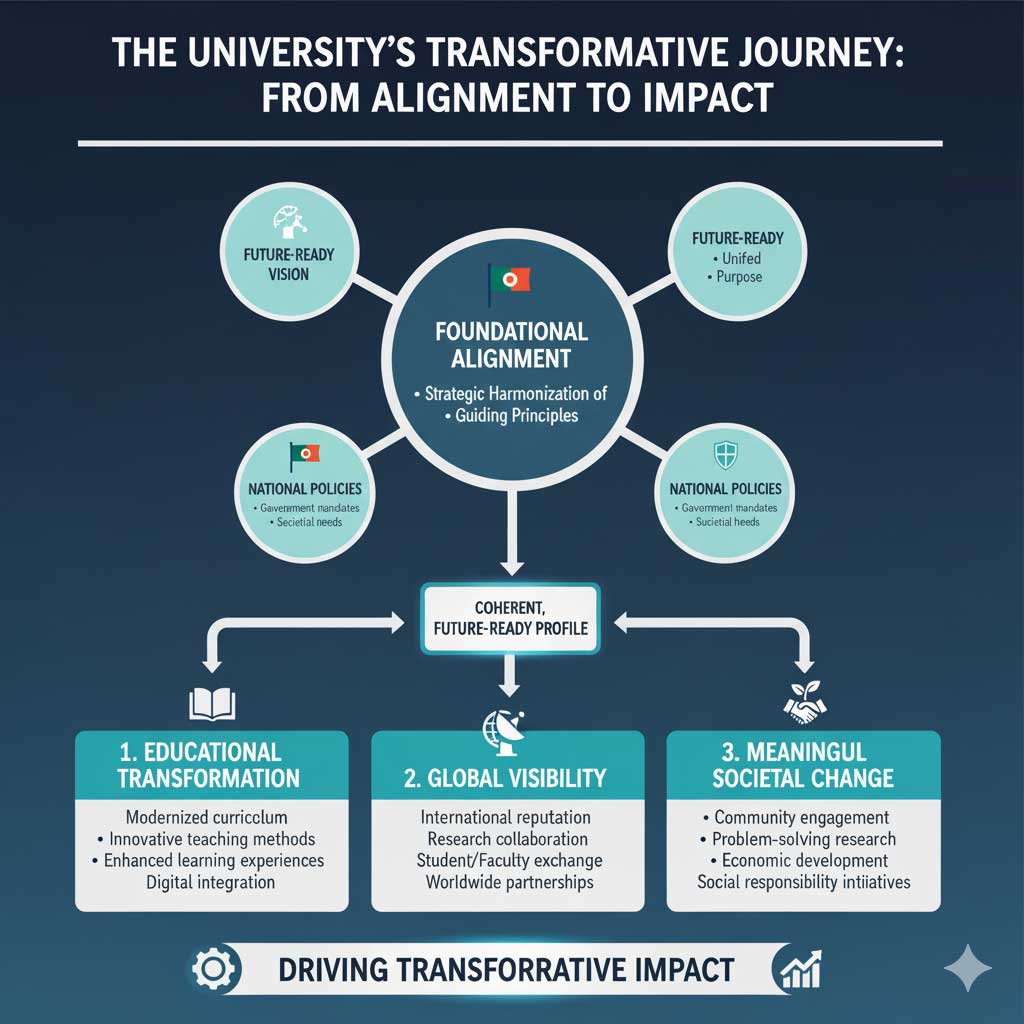
Ultimately, the integration of SDGs and internationalization offers a unified vision for institutional transformation. Rankings such as THE Impact, WURI, UI GreenMetric, and QS Stars provide platforms to measure and showcase impact. As Chankseliani and McCowan (2021) note, higher education institutions play a critical role in achieving the SDGs by fostering innovation, equity, and sustainability. By aligning global frameworks with national policies and institutional strategies, universities can build a coherent, future-ready profile that drives educational transformation, global visibility, and meaningful societal change. Figure depicts the whole summary of this narrative.
By Engelbert Calimlim Pasag, PhD
Panpacific University, Urdaneta City, Pangasinan
Ylang Ylang Readspark Library and Innovation Hub, Sison, Pangasinan
EduCommunity Plus Consulting Corporation, Ayala Triangle Gardens Tower 2, Makati City